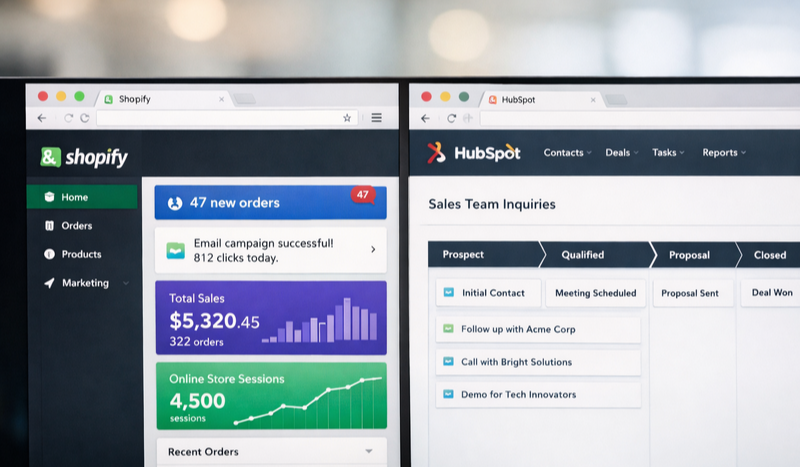
You're staring at two browser tabs. One has your Shopify dashboard showing 47 new orders from last night's email campaign. The other has HubSpot, where you're manually copying customer data because... that's just how it's always been done. Somewhere between order #23 and #24, you think: there has to be a better way.
There is. The best Shopify HubSpot integration for most e-commerce businesses is Unific - it offers deep, bidirectional data syncing that transforms how your marketing and sales teams operate. But that answer only matters if you understand why it beats the alternatives and whether it fits your specific situation.
As a certified HubSpot partner, LevelUp Digital has helped dozens of e-commerce brands navigate this exact decision. Let's break down what's actually out there and why the choice matters more than most people realize.
What Is a Shopify HubSpot Integration?
Think of a Shopify HubSpot integration as a translator standing between two people who speak different languages. Your Shopify store speaks in orders, products, and transactions. HubSpot speaks in contacts, deals, and marketing campaigns. Without a translator, these systems just... talk past each other.
An integration syncs data between the two platforms automatically. Customer makes a purchase on Shopify? That information flows into HubSpot. Someone abandons their cart? HubSpot knows instantly. A contact's lifecycle stage changes in HubSpot? Your Shopify marketing tools can respond accordingly.
The quality of that translation - how much data moves, how fast it moves, and how accurately it moves - varies wildly depending on which integration you choose. And that's where things get interesting.
The Shopify HubSpot Integration Landscape in 2024
Before we crown a winner, you need to understand your options. There are essentially four paths you can take, each with distinct tradeoffs.
Option 1: HubSpot's Native Shopify Integration
HubSpot offers a built-in Shopify connector that's free with your subscription. It handles basic contact syncing and can pull in order data. For a small shop doing light email marketing, it technically works.
The catch? It's surface-level. You get contacts and basic purchase history, but the sync is often delayed, product data is limited, and abandoned cart workflows require workarounds. It's like having a translator who only knows 200 words - functional for ordering coffee, useless for negotiating a business deal.
Option 2: Zapier or Make
These workflow automation tools let you build custom connections between Shopify and HubSpot. Trigger an event in Shopify, and Zapier creates or updates something in HubSpot. Flexible? Absolutely. Sustainable? That depends on your patience.
The problem is maintenance. Each "Zap" is another thing that can break. Shopify updates an API, your Zap fails silently, and suddenly you've got three weeks of missing customer data. I've seen teams spend more time fixing Zapier workflows than they would've spent on manual data entry.
Option 3: Custom API Development
If you have developers on staff and very specific needs, building a custom integration gives you complete control. You decide exactly what data moves where and when.
The reality? Custom integrations cost $10,000 to $50,000 to build properly and require ongoing maintenance. For enterprise e-commerce operations, this sometimes makes sense. For most brands doing $1M to $20M annually, it's overkill that burns budget better spent on actual marketing. Our custom web development team has built these integrations - and we're usually the first to recommend a proven third-party solution instead.
Option 4: Dedicated E-Commerce Integration Platforms
This is where tools like Unific, Ecommerce Bridge, and a handful of others live. These platforms exist specifically to connect e-commerce stores with CRMs and marketing automation tools. They're purpose-built, deeply integrated, and maintained by teams whose entire business depends on that connection working flawlessly.
E-commerce brands using dedicated integration platforms report saving an average of 15-20 hours per week on manual data management tasks - time that gets reinvested into strategy and customer relationships.
Why Unific Stands Out as the Best Shopify HubSpot Integration
After testing multiple options with clients across industries - from fashion retailers to B2B wholesale suppliers - Unific consistently delivers the most value for e-commerce teams already invested in HubSpot.
Bidirectional Sync That Actually Works
Most integrations push data one direction - Shopify to HubSpot. Unific syncs both ways. Update a contact's properties in HubSpot, and those changes can flow back to influence Shopify operations. This matters when your customer service team updates preferences in HubSpot that should affect future Shopify experiences.
Historical Data Import
Here's something that trips up many brands: most integrations only sync data going forward from the moment you connect. All those customer relationships you've built over years? Gone. Unific lets you import historical Shopify data into HubSpot, giving your marketing automation the full picture from day one.
Granular Product and Order Syncing
With Unific, every line item, discount code, shipping detail, and product variant flows into HubSpot. Want to segment customers who bought a specific product variant during a specific promotion last Q4? You can actually do that. The native HubSpot integration doesn't give you that level of detail.
Real-Time Abandoned Cart Recovery
Abandoned cart workflows are e-commerce gold, but timing is everything. Unific pushes abandoned cart data to HubSpot in near real-time, letting you trigger recovery emails within minutes - not hours. According to Barilliance's research, the average cart abandonment rate sits around 70%, making fast recovery workflows essential for revenue.
Pro Tip: Set up your abandoned cart email sequence to send the first message within 30 minutes of abandonment. Unific's real-time sync makes this possible - something you can't reliably achieve with the native integration or Zapier-based solutions.
What Does Unific Actually Cost?
Transparency matters here. Unific isn't free - plans start around $100/month and scale based on your Shopify order volume and the features you need. Compared to the native free option, that feels like a lot until you do the math on your time.
If your HubSpot admin spends even 5 hours per week on manual data tasks that Unific would eliminate, and you value that time at $50/hour, you're looking at $1,000/month in labor cost. The integration pays for itself before you even factor in improved marketing performance from better data.
For brands serious about building a unified view of their customers, you can explore Unific's pricing and plans here.
How Does Unific Compare to Other Dedicated Integrations?
Unific isn't the only dedicated e-commerce integration platform. Here's how it stacks up against common alternatives.
Unific vs. HubSpot's Ecommerce Bridge
HubSpot's Ecommerce Bridge is more of a framework than a finished product. It requires significant technical setup and developer time. Unific is plug-and-play for most Shopify stores - you're up and running in hours, not weeks.
Unific vs. Revenue Conduit
Revenue Conduit offers similar functionality but tends to focus more heavily on Magento and WooCommerce stores. If Shopify is your platform, Unific's Shopify-specific optimizations give it an edge in reliability and feature depth.
Unific vs. Data Sync Solutions (Skyvia, etc.)
General-purpose data sync tools can technically connect Shopify to HubSpot, but they lack e-commerce-specific logic. They don't understand what an abandoned cart is or how product variants should map to HubSpot properties. You end up building that logic yourself - essentially paying less for software while paying more for implementation.
Setting Up Your Shopify HubSpot Integration: What to Expect
Whether you choose Unific or another solution, the setup process follows a similar pattern. Understanding this helps you plan resources and set realistic timelines.
Phase 1: Data Mapping (1-2 Days)
Before connecting anything, you need to decide what data goes where. Which Shopify fields map to which HubSpot properties? How do you handle customers who exist in both systems? This planning phase prevents headaches later.
Phase 2: Initial Sync (1-3 Days)
The first sync imports historical data and establishes the connection. Depending on your order volume, this can take anywhere from a few hours to several days. Unific handles this automatically once you configure your preferences.
Phase 3: Workflow Building (Ongoing)
With data flowing, you can build the automation workflows that actually drive results. Abandoned cart sequences, post-purchase follow-ups, VIP customer identification, win-back campaigns - this is where the integration starts paying dividends. Having a solid content strategy ready to deploy through these workflows accelerates your results.
Common Mistakes When Integrating Shopify with HubSpot
After helping numerous e-commerce brands through this process, patterns emerge. Avoid these pitfalls.
Mistake 1: Syncing Everything Without Purpose
More data isn't always better. Syncing every possible field clutters your HubSpot instance and slows down your team. Start with essential data - contact info, purchase history, cart activity - and add more fields only when you have a specific use case.
Mistake 2: Ignoring Duplicate Management
Customers might exist in both systems with slightly different email addresses or formatting. Without a deduplication strategy, you'll create confusion and inaccurate reporting. Most dedicated integrations including Unific have deduplication features - use them.
Mistake 3: Not Training Your Team
An integration is only as valuable as your team's ability to use the data it provides. Budget time for training your marketing and sales teams on what new data is available and how to act on it.
Pro Tip: Create a simple one-page reference guide showing your team which Shopify data lives in which HubSpot properties. Update it whenever you modify your sync settings. This small documentation effort prevents countless "where do I find..." Slack messages.
What Results Can You Expect from a Proper Integration?
Let's get concrete about outcomes. E-commerce brands with well-implemented Shopify HubSpot integrations typically see:
- 20-40% recovery rate on abandoned carts when fast, personalized follow-up sequences are deployed
- 15-25% increase in repeat purchase rate through targeted post-purchase nurturing
- Significant time savings for marketing operations - no more manual exports, imports, or spreadsheet reconciliation
- More accurate attribution connecting marketing spend to actual revenue, not just clicks
These aren't guaranteed numbers - they depend on your products, audience, and how well you execute. But they illustrate what becomes possible when your systems actually talk to each other.
Is Unific Right for Your Business?
Unific shines brightest for e-commerce brands that meet a few criteria:
- You're already using HubSpot for marketing automation or CRM
- Your Shopify store processes at least 100+ orders monthly
- You have someone (internal or agency) capable of building HubSpot workflows
- You value time savings and data accuracy over the lowest possible cost
If you're just getting started with e-commerce and running a handful of orders per week, the native HubSpot integration might suffice for now. But the moment you want to get serious about customer lifecycle marketing, you'll hit its limits fast.
For brands ready to scale, Unific provides the foundation your growth strategy needs.
Frequently Asked Questions About Shopify HubSpot Integration
How long does it take to set up a Shopify HubSpot integration?
With Unific, most stores can complete basic setup in 2-4 hours. Historical data import adds time depending on volume. Plan for 1-2 weeks to fully configure, test, and build initial workflows before considering it "done."
Will the integration slow down my Shopify store?
No. Quality integrations like Unific operate asynchronously - they don't affect your storefront performance. Data syncs happen in the background without impacting page load times or checkout speed.
Can I sync Shopify data to HubSpot custom objects?
Yes, though this depends on your HubSpot tier. With HubSpot Enterprise and Unific, you can map Shopify data to custom objects like Orders or Line Items for more sophisticated reporting and automation.
What happens to my data if I cancel the integration?
Data already synced to HubSpot stays in HubSpot - it's your data. However, new Shopify activity would stop flowing over. Most brands export a final sync before disconnecting to ensure completeness.
Making the Right Choice for Your E-Commerce Stack
Choosing a Shopify HubSpot integration isn't just a technical decision - it's a strategic one. The right integration becomes invisible infrastructure that powers personalization, automation, and growth. The wrong one creates friction, frustration, and missed opportunities.
For most e-commerce brands already committed to HubSpot, Unific delivers the best balance of capability, reliability, and value. It eliminates the busywork that keeps your marketing team from doing actual marketing. And it gives you the unified customer view that makes sophisticated lifecycle campaigns possible.
Your brand identity matters in every customer touchpoint - from your logo design to your post-purchase emails. A proper integration ensures those touchpoints are informed by complete, accurate customer data rather than guesswork and manual processes.
The e-commerce brands winning in 2024 aren't just collecting data - they're connecting it. Your Shopify HubSpot integration is where that connection happens. Make it count.
Ready to Level Up?
As a certified HubSpot partner, LevelUp Digital helps e-commerce brands implement integrations that actually drive results. Let's talk about connecting your Shopify store to HubSpot the right way.
Schedule a Free Strategy Call


 Heather Harrington

 Heather Harrington: Sep 21, 2026, 9:45:00 AM



%20-%202026-03-27T093044.779.png)