Google March 2026 Core Update: What Changed and How to Adapt
19:28
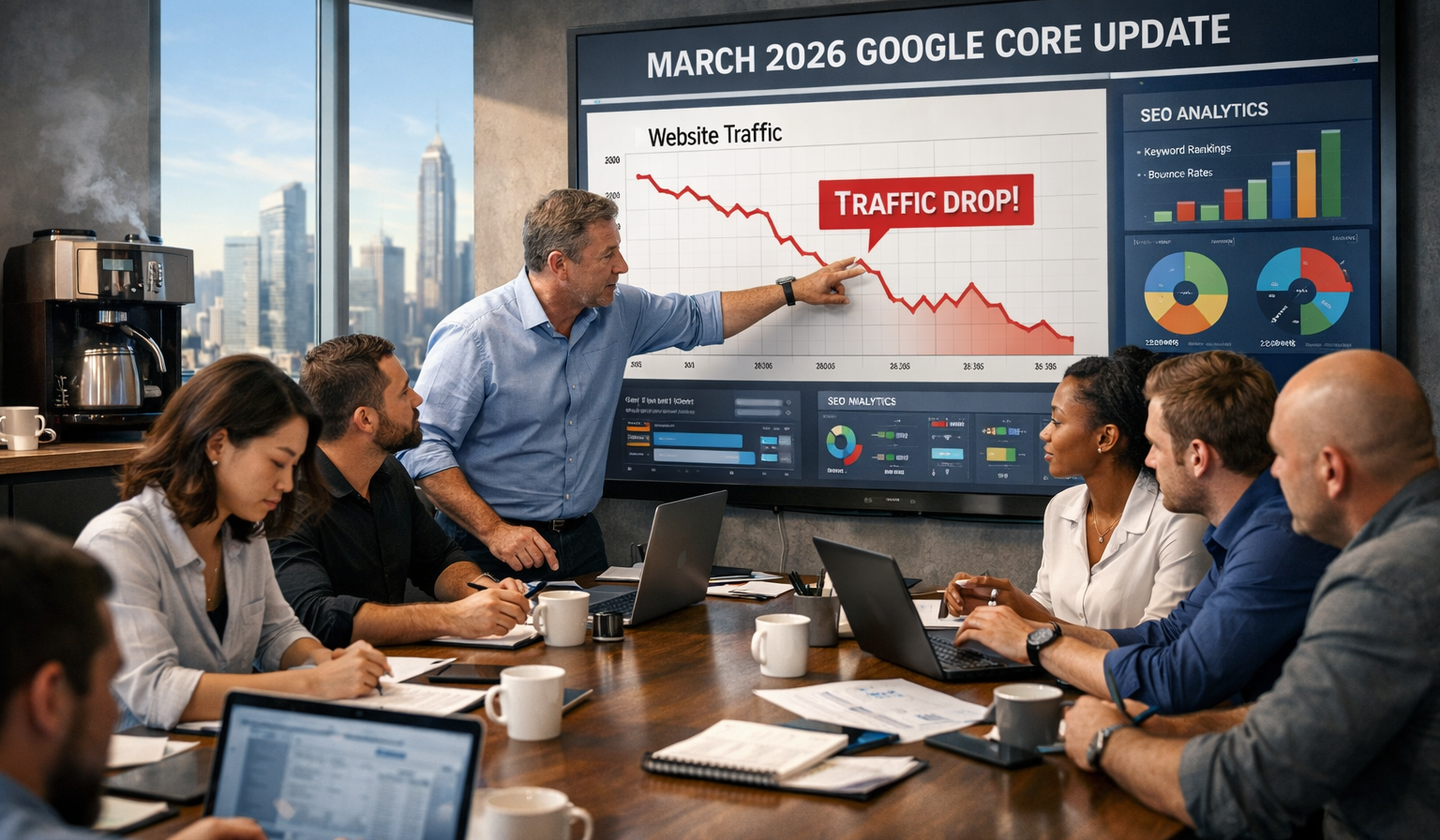
You checked your analytics on a Tuesday morning in late March, coffee still warm in your hand. Traffic was down 34%. Rankings you'd held for two years had vanished overnight. Your phone started buzzing with messages from your team, all asking the same thing: What happened?
If this sounds familiar, you're not alone. The Google March 2026 Core Update rolled out between March 11-28, and it left a trail of confused marketers, panicked business owners, and a lot of scrambling SEO professionals trying to piece together what changed. This wasn't just another routine update... it fundamentally shifted how Google evaluates content quality, user intent, and website authority.
Here's the bottom line: The March 2026 update prioritizes what Google calls "experiential authority" - content that demonstrates real-world expertise through original data, first-hand experience, and verifiable credentials. Sites that relied on aggregated information or AI-generated content without substantial human oversight saw significant ranking drops, while those with genuine expertise climbed.
What Is the Google March 2026 Core Update?
The Google March 2026 Core Update is a broad algorithm change that modified how Google's ranking systems assess content across the entire search index. Unlike targeted updates that focus on specific issues like spam or link manipulation, core updates recalibrate the overall criteria Google uses to determine which pages deserve top positions.
Think of it like this: if Google's algorithm were a recipe, a core update doesn't just tweak the salt - it rethinks the entire dish. The March 2026 version essentially told Google's systems to place far more weight on demonstrated expertise and far less on traditional signals like keyword optimization and backlink volume alone.
Google's Danny Sullivan confirmed in a Search Central blog post that this update specifically enhances their ability to identify "content created by people with genuine, demonstrable experience in their subject matter." That phrase - demonstrable experience - became the key to understanding everything that followed.
Why This Update Hit So Many Sites Hard
Let's be honest about what's been happening in content marketing over the past few years. The rise of AI writing tools made it incredibly easy to produce massive volumes of "good enough" content. Many businesses - including some pretty sophisticated ones - leaned into this approach. Publish more, rank for more keywords, capture more traffic.
The March 2026 update essentially called that bluff.
Early data from multiple SEO research firms tells a stark story. According to analysis from Semrush covering 1.2 million domains, sites that lost more than 25% of their organic traffic shared some clear patterns: thin content, lack of author attribution, and heavy reliance on generalized information available elsewhere.
Sites demonstrating first-hand expertise through original research, case studies, or verifiable author credentials saw an average ranking improvement of 18% for competitive keywords - while sites relying primarily on aggregated information experienced an average decline of 31%.
The winners? They looked different. Sites with clear author bios linking to verifiable credentials. Content featuring original data or proprietary research. Pages that answered questions in ways that could only come from someone who'd actually done the thing they were writing about.
What the Early Studies Reveal About Ranking Changes
Within weeks of the rollout completing, several major SEO research organizations published their initial findings. While we should treat early data with appropriate caution - algorithm impacts often shift as Google fine-tunes - the patterns are consistent enough to draw some conclusions.
The Sistrix Visibility Index Analysis
Sistrix analyzed visibility changes across 50,000 domains in the US market. Their findings showed that health, finance, and legal niches - the classic YMYL (Your Money, Your Life) categories - saw the most dramatic shifts. Sites in these verticals without clear expert authorship lost an average of 42% visibility.
Interestingly, smaller niche sites with deep expertise often outperformed larger publishers with broader coverage. A single-author blog run by a practicing physician gained visibility in medical search results, while a major health media company with staff writers saw declines.
The Moz Domain Authority Correlation Study
Moz's research team examined whether traditional metrics like Domain Authority still predicted rankings post-update. Their conclusion: DA remains relevant, but its predictive power decreased by roughly 15% compared to pre-update measurements. The gap is being filled by what they're calling "topical authority signals" - how well a site demonstrates expertise within specific subject areas.
Search Engine Journal's Content Analysis
Perhaps most actionable, Search Engine Journal's team analyzed 500 pages that gained rankings and 500 that lost them. The differences were telling:
Characteristic
Pages That Gained
Pages That Lost
Author bio with credentials
87%
23%
Original data or research
64%
12%
First-person experience mentioned
71%
28%
Cited external sources
79%
45%
Word count over 2,000
58%
52%
Notice that last row. Word count - long considered a ranking factor - showed almost no correlation with outcomes. Depth of expertise mattered far more than depth of word count.
How Can I Tell If My Site Was Affected by the March 2026 Update?
Before you optimize for anything, you need to understand whether - and how severely - your site was impacted. Not every traffic drop is algorithm-related, and misdiagnosing the problem leads to wasted effort.
Start by checking your Google Search Console data for the period between March 11-28. Look specifically at these metrics:
Total clicks and impressions: Did both drop simultaneously? That suggests a visibility issue, likely algorithm-related.
Average position changes: Filter by your most important pages. Did positions shift across the board or just for specific content?
Query-level data: Which search terms lost rankings? Are they informational queries, transactional, or both?
If you see a clear inflection point during the rollout window - especially if it affected multiple pages across different topics - you're likely looking at core update impact. If the changes are isolated to specific pages or started before or after the rollout dates, other factors might be at play.
Understanding how Google processes and ranks the 5 trillion annual searches helps put these changes in context. Every algorithm update is Google's attempt to serve better results to that massive query volume.
The Complete Optimization Strategy for the New Algorithm
Alright, let's get practical. If you've been hit by this update - or want to protect yourself from future ones - here's a comprehensive approach based on what the data is telling us.
1. Establish Clear Author Expertise
This is no longer optional. Every piece of content on your site needs a clearly attributed author with verifiable credentials. Not just a name - actual credentials that demonstrate why this person is qualified to write about this topic.
For your author pages, include:
Professional background and relevant experience
Certifications, degrees, or professional memberships
Links to other published work or speaking engagements
Social proof like LinkedIn profiles or industry recognition
If your content is written by your marketing team rather than subject matter experts, consider a hybrid approach: have experts review and validate content, then attribute authorship appropriately. "Written by [Marketing Person], reviewed by [Expert]" is far better than no attribution at all.
Pro Tip: Implement structured data for your author pages using Person schema. This helps Google connect your content to real, verifiable individuals - which is exactly what they're looking for. Here's our complete guide to website schema to get started.
2. Inject Original Research and Data
Nothing screams "we actually know this stuff" like original data. The March 2026 update clearly rewards content that contributes something new rather than just repackaging existing information.
You don't need a massive research department to do this. Consider:
Customer surveys: Even 100 responses to a well-designed survey gives you original data to reference
Internal case studies: Document your actual results with specific numbers and methodologies
Tool-based analysis: Use industry tools to analyze trends and publish your findings
Expert interviews: Original quotes from industry professionals add unique value
When you publish original research, other sites link to it naturally. This creates a virtuous cycle where your demonstrated expertise generates the authority signals Google values.
3. Demonstrate First-Hand Experience
The E-E-A-T framework (Experience, Expertise, Authoritativeness, Trustworthiness) got a major emphasis on that first E in this update. Google wants to see that you've actually done the thing you're writing about.
This shows up in subtle but important ways:
Screenshots of actual dashboards or tools you use
Specific examples from real projects (anonymized if needed)
Discussion of challenges you encountered and how you solved them
Before-and-after results with methodology explained
A guide to email marketing written by someone who's sent millions of emails reads differently than one written by someone who researched the topic. Google's getting better at detecting that difference.
4. Audit Your Existing Content Library
Most sites don't need to start from scratch - they need to upgrade what they have. Conduct a systematic audit of your existing content with these questions:
Does this page have a clear, credentialed author?
Does it contain any original insights, data, or perspectives?
Could this content only be written by someone with real experience?
Are claims supported by credible sources?
Pages that fail multiple criteria are candidates for either significant revision or consolidation. Better to have 50 excellent, authoritative pages than 200 mediocre ones.
5. Build Topical Authority Through Content Architecture
Random blog posts on whatever seems trending won't cut it anymore. The update rewards sites that demonstrate deep expertise in defined subject areas.
Structure your content into topic clusters:
Pillar pages: Comprehensive guides on major topics you want to own
Supporting content: Detailed posts that go deep on subtopics
Internal linking: Connect related content so Google understands your topical authority
For example, if you're a marketing agency claiming expertise in marketing automation, you should have interconnected content covering strategy, platforms, implementation, measurement, and troubleshooting. Our piece on simple business automations is one node in that kind of topical structure.
What Industries Were Most Affected by This Update?
While the March 2026 update affected all search categories, impact varied dramatically by industry. Understanding where your sector falls helps calibrate your response.
High Impact Industries
Healthcare and Medical: Massive volatility. Sites without clear medical professional authorship saw severe drops. Telemedicine companies and health information sites were particularly affected.
Financial Services: Similar story. Content about investing, insurance, and financial planning now requires demonstrable financial expertise. Generic "financial tips" content got hammered.
Legal: Law firm blogs and legal information sites saw significant reshuffling. Attorney-authored content rose; generic legal guides fell.
B2B Software/SaaS: Moderate to high impact. Product comparison and "best of" content was hit hard unless backed by actual testing and expertise.
Moderate Impact Industries
E-commerce: Product pages were largely stable, but buying guides and informational content shifted. Expertise in product selection matters more.
Professional Services: Agencies and consultancies with clear expertise profiles fared well. Those with thin "service page only" sites struggled.
Lower Impact Industries
Local businesses: Minimal change for most local search results, though review signals may have gotten a slight boost.
News and journalism: Established publications with editorial processes remained stable. The update focused more on evergreen content than breaking news.
How Long Does It Take to Recover From a Core Update?
This is the question everyone asks, and the honest answer is: it depends, and it takes longer than you want.
Based on historical core update patterns, meaningful recovery typically requires:
Content improvements: 4-8 weeks minimum to see initial impact from changes
Building authority signals: 3-6 months of consistent expertise demonstration
Full recovery: Often not until the next major core update, when Google fully re-evaluates sites
The uncomfortable truth is that Google's core updates don't operate on real-time reassessment. You can make every recommended improvement today and still wait months to see rankings return. This isn't punishment - it's just how the system works.
That said, some sites have reported faster partial recoveries when they made dramatic, comprehensive changes rather than incremental tweaks. If your content has fundamental expertise gaps, fixing a few pages won't move the needle. You need to transform your overall content approach.
What Does This Mean for AI-Generated Content?
Let's address the elephant in the room. Yes, this update has major implications for AI content.
Google has never said AI-generated content is inherently bad for rankings. What they've consistently said - and what this update reinforces - is that content quality matters regardless of how it's produced. The problem isn't that AI wrote something. The problem is that much AI content lacks the experiential markers that this update rewards.
AI can research. AI can synthesize. AI can even write coherently. What AI can't do is have genuine experience. It can't run marketing campaigns and learn from failures. It can't implement technical solutions and discover unexpected challenges. It can't build expertise through years of practice.
The winning approach going forward isn't "no AI" - it's "AI as assistant, human as expert." Use AI to accelerate research, draft initial structures, or handle routine content tasks. But the expertise, the original insights, the genuine experience... those need to come from humans who have them.
Technical SEO Considerations Post-Update
While content expertise dominated the headlines around this update, several technical factors appear to have gained importance as well.
Page Experience Signals
Core Web Vitals didn't change, but their weight may have increased. Sites with poor performance metrics saw amplified negative effects when combined with content issues. If your site was borderline on expertise signals, technical problems made things worse.
Structured Data Implementation
Proper schema markup - especially Person, Organization, and Article schema - correlates with better outcomes. This makes sense: structured data helps Google understand and verify your expertise claims. Our custom development team has been helping clients implement comprehensive schema strategies for exactly this reason.
Site Architecture and Crawlability
Clean site structures that help Google understand your topical focus performed better. Sites with random content sprawl - posts on every conceivable topic - struggled more than focused sites with clear expertise boundaries.
Building Your Post-Update SEO Strategy
Here's a practical timeline for responding to the March 2026 update:
Weeks 1-2: Assessment
Analyze Search Console data to understand specific impact
Audit your highest-traffic pages for expertise signals
Identify your strongest subject matter experts internally
Weeks 3-6: Foundation Building
Create or enhance author pages with verifiable credentials
Implement Person and Article schema across your site
Begin revising your most important content with expertise indicators
Months 2-4: Content Enhancement
Add original data, case studies, or research to key pages
Build topical clusters around your core expertise areas
Strengthen internal linking between related expert content
Months 4-6: Authority Development
Pursue opportunities for expert-authored guest content
Develop relationships with industry publications
Create link-worthy original research or tools
Working with an experienced SEO team can accelerate this process significantly, especially for the technical implementation and strategic planning components.
Looking Ahead: What This Update Tells Us About Google's Direction
The March 2026 update isn't an isolated event - it's the clearest signal yet of where Google is heading. A few themes emerge:
Quality over quantity: The era of winning through content volume alone is definitively over. Better to publish less, with more depth and genuine expertise.
Human expertise matters more, not less: In an age of AI content proliferation, demonstrated human expertise becomes a key differentiator. Google is building systems to detect and reward it.
Trust signals are expanding: Traditional authority metrics like backlinks still matter, but they're increasingly supplemented by signals of real-world expertise and experience.
Topical focus beats broad coverage: Trying to rank for everything means ranking well for nothing. The winners are those who go deep in defined areas.
For businesses and marketers, the message is clear: invest in genuine expertise, document it publicly, and let your real knowledge differentiate you from competitors who are just playing the SEO game. That's not just good for rankings - it's good business strategy.
The sites that will thrive in this new environment aren't the ones with the biggest content budgets or the most sophisticated SEO tactics. They're the ones where you can tell, immediately upon reading, that the author actually knows what they're talking about.
And honestly? That's probably how it should have worked all along.
Ready to Level Up?
Navigating algorithm updates shouldn't mean starting from scratch. Our SEO experts can audit your site, identify expertise gaps, and build a recovery strategy tailored to your business.
Picking a social media advertising agency when you're running a small or mid-sized business is a different game than it is for enterprise brands with...


 Heather Harrington


 Heather Harrington: Sep 21, 2026, 9:45:00 AM