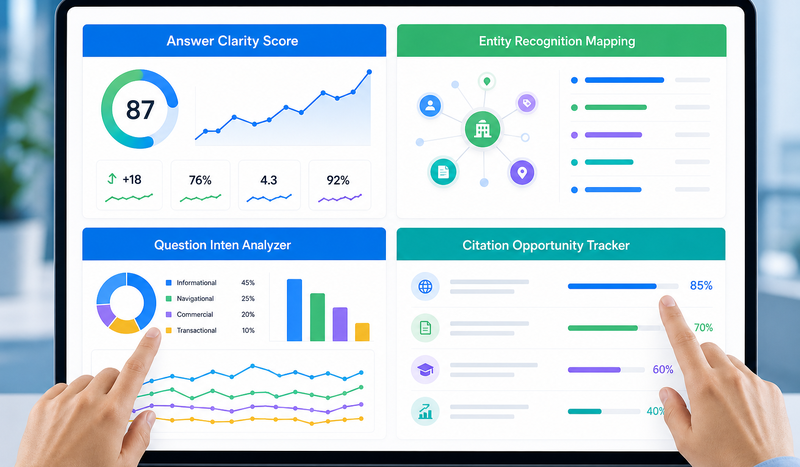
You know that moment when a prospect tells you they found your competitor through ChatGPT? Not Google. Not a referral. An AI assistant just... recommended them. That's the new reality of search, and it's reshaping how brands get discovered online.
To optimize your marketing for AI search and Answer Engine Optimization (AEO), you need to structure your content so AI systems can easily extract, understand, and cite your information. This means creating clear, direct answers to specific questions, building topical authority through comprehensive coverage, and ensuring your technical foundations support AI crawlers.
The brands winning in this new landscape aren't necessarily the ones with the biggest budgets. They're the ones who understood early that the rules of discovery have fundamentally changed.
What is Answer Engine Optimization (AEO)?
Think of traditional SEO as optimizing for a librarian who helps people find the right book. AEO is optimizing for a research assistant who reads all the books and synthesizes an answer on the spot.
Answer Engine Optimization is the practice of structuring your content so AI-powered search tools - think ChatGPT, Perplexity, Google's AI Overviews, and Claude - can easily extract and cite your information when users ask questions. Instead of just ranking for keywords, you're positioning your brand to be the source that AI systems trust and reference.
The fundamental shift here is important. Traditional search sends users to your website. AI search often gives users the answer directly, with your brand mentioned as the source... or not mentioned at all if your content isn't structured correctly.
According to Gartner research, traditional search engine volume is expected to drop 25% by 2026 as consumers shift to AI chatbots and virtual agents for their queries.
That statistic should make every marketer pause. We're not talking about a minor channel shift. This is a fundamental reimagining of how people find information and make decisions.
Why Traditional SEO Alone Won't Cut It Anymore
Let's be clear - SEO isn't dead. Building a strong content strategy still matters enormously. But the game has expanded.
Here's what's happening. When someone asks Google a question now, they might see an AI Overview at the top - a synthesized answer pulled from multiple sources. When someone asks ChatGPT for a recommendation, it draws from its training data and real-time web access to provide direct guidance. When someone uses Perplexity, they get cited sources inline with conversational answers.
In all these scenarios, the traditional "ten blue links" model is either supplemented or replaced entirely. Your brilliant blog post might rank third organically but never get clicked because the AI answered the question first.
How Do AI Search Engines Decide What to Cite?
AI systems don't think like Google's traditional algorithm. They're looking for content that demonstrates genuine expertise, provides clear and direct answers, maintains consistency across the web, and comes from sources with established authority in their space.
The signals that matter include:
- Content clarity: Can an AI easily extract a concise answer from your page?
- Topical depth: Do you cover subjects comprehensively, not superficially?
- Entity recognition: Is your brand consistently described across platforms?
- Freshness: Is your information current and regularly updated?
- Structured data: Does your technical markup help AI understand your content?
Notice what's not on that list? Keyword density. Backlink volume. Domain age. Those traditional SEO factors still influence rankings, but AI systems are evaluating content differently.
Practical AEO Strategies That Actually Work
Enough theory. Let's talk about what you can actually do starting this week to improve your visibility in AI search results.
Structure Content for Direct Extraction
Every piece of content you create should have what I call an "AI-friendly answer block" near the top. This is a clear, concise response to the main question your content addresses - usually two to four sentences that an AI could pull directly as an answer.
You'll notice this article follows that pattern. The second paragraph directly answers "how to optimize for AI search" before diving into the details. This isn't just good for AI - it's good for readers who want quick answers too.
Pro Tip: Write your summary paragraph first, then build the detailed content around it. This ensures you always have a clear, extractable answer and keeps your content focused on actually answering the question.
Build Topical Authority Through Content Clusters
AI systems assess whether you're a credible source partly by evaluating how comprehensively you cover a topic. One blog post about marketing strategy doesn't make you an authority. A interconnected collection of content covering strategy, execution, measurement, and optimization does.
This means thinking about your content as an ecosystem rather than individual pieces. Each new piece you publish should strengthen the overall authority of your content library on your core topics.
Map out the questions your ideal customers ask throughout their journey, then create content that answers each one while linking to related pieces. The internal linking structure signals to both traditional search engines and AI systems that you have depth on these subjects.
Optimize Your Entity Presence
Your brand is an "entity" in the knowledge graph that powers AI systems. The more consistent and comprehensive your entity information, the more likely AI will recognize and cite you.
Start with the basics:
- Claim and fully complete your Google Business Profile
- Ensure consistent NAP (name, address, phone) across all directories
- Create or update your Wikipedia page if you're notable enough
- Maintain active, consistent social media profiles
- Get mentioned in industry publications and relevant roundups
Your website's design and user experience also plays a role here. Sites that are well-organized, fast-loading, and clearly structured are easier for AI crawlers to parse and understand.
Technical Foundations for AI Search Visibility
The creative and strategic elements of AEO get most of the attention, but your technical infrastructure matters too. AI systems need to be able to crawl, parse, and understand your content efficiently.
Schema Markup is Non-Negotiable
Structured data helps AI systems understand not just what your content says, but what it means. At minimum, you should implement FAQ schema for question-and-answer content, Article schema for blog posts and news content, Organization schema for your brand information, Product schema for anything you sell, and HowTo schema for instructional content.
This isn't about gaming the system. It's about speaking the language that AI systems understand. When you mark up a question and answer with FAQ schema, you're explicitly telling AI crawlers "this is a direct answer to this specific question."
Does My Site Need to Be Accessible to AI Crawlers?
Yes, and this is where some brands accidentally shoot themselves in the foot. Check your robots.txt file - you might be blocking the very crawlers that power AI search tools. GPTBot (OpenAI's crawler), Google-Extended (for Bard/Gemini), and CCBot (used by many AI training datasets) all need access if you want AI visibility.
Some publishers are blocking these crawlers over content licensing concerns, which is a valid business decision. But if visibility in AI search matters to you, those crawlers need access to your content. Working with experienced web developers can help ensure your technical setup supports your AEO goals.
Content Formats That Win in AI Search
Not all content is equally useful for AI systems. Some formats naturally lend themselves to extraction and citation.
What Type of Content Gets Cited by AI?
Based on what we're seeing in client campaigns and industry research, certain content types consistently outperform others in AI search visibility.
Definitive guides that comprehensively cover a topic from multiple angles tend to be cited frequently. They signal deep expertise and provide AI systems with rich material to draw from.
Original research and data is gold for AI citations. When you publish unique statistics, survey results, or case studies, you become a primary source that AI must cite when discussing those findings.
Clear how-to content with step-by-step instructions performs well because it directly answers "how do I..." questions that users commonly ask AI assistants.
Comparison and evaluation content - the kind that objectively weighs options - gets pulled into AI responses when users ask for recommendations or advice.
What doesn't work as well? Thin content that restates what everyone else says. Overly promotional material. Content buried behind aggressive pop-ups or paywalls. AI systems are remarkably good at identifying content that actually helps versus content that just exists for SEO purposes.
Measuring Success in the AEO Era
Here's an uncomfortable truth: tracking AI search performance is harder than tracking traditional SEO. When ChatGPT cites you, there's no referral data in your analytics. When Google's AI Overview uses your content, the user might never click through.
So how do you know if your AEO efforts are working?
Start by manually testing. Regularly ask AI tools questions relevant to your business and see if you're cited. Track brand mentions using tools like Mention or Brand24 to catch AI-driven references. Monitor branded search volume - if AI is recommending you, branded searches often increase as people verify recommendations.
Watch your "Position Zero" performance in traditional search as well. Featured snippets and AI Overviews often pull from the same optimized content. If you're winning snippets, you're likely well-positioned for AI citations too.
Pro Tip: Create a monthly "AI audit" ritual where you test 10-15 questions related to your core services across ChatGPT, Perplexity, and Google. Document who gets cited and analyze what those sources are doing differently.
The Relationship Between Brand Authority and AI Visibility
Something interesting happens when you talk to marketers who are succeeding in AI search. They often describe efforts that sound less like traditional SEO and more like PR and brand building.
That's not a coincidence. AI systems are trained to recognize and trust established authorities. Your brand identity and reputation directly influence how AI systems perceive and cite you.
Getting mentioned in respected industry publications, having executives quoted as experts, maintaining an active thought leadership presence, earning positive reviews and testimonials - these "soft" signals are becoming hard currency in AI search visibility.
According to Search Engine Journal's research on AI search optimization, brands with strong E-E-A-T signals (Experience, Expertise, Authoritativeness, Trustworthiness) consistently outperform competitors in AI-generated results, regardless of traditional domain metrics.
Future-Proofing Your AEO Strategy
AI search is evolving rapidly. What works today might shift as these systems mature. But some principles will likely remain constant.
Creating genuinely helpful content will always matter. AI systems are getting better at distinguishing substance from fluff, not worse. The bar for "quality content" is rising, not falling.
Clarity will continue to be rewarded. Confusing, jargon-heavy, poorly organized content is hard for humans and AI alike. Simple, clear communication wins.
Technical accessibility will remain foundational. Whether it's AI crawlers, screen readers, or voice assistants, content that's technically well-structured reaches more people and systems.
Brand building compounds over time. The trust signals you build today influence how AI systems perceive you months and years from now. There's no shortcut to genuine authority.
Getting Started This Week
AEO can feel overwhelming, but you don't need to overhaul everything overnight. Start with these focused actions.
First, audit your top ten performing pages. Do they have clear, extractable answer paragraphs near the top? If not, add them.
Second, check your schema markup. Is it implemented correctly? Are you missing obvious opportunities like FAQ schema on pages that answer questions?
Third, review your robots.txt and make a conscious decision about AI crawler access. Don't let the default settings make this choice for you.
Fourth, test your visibility. Ask ChatGPT, Perplexity, and Google's AI assistant questions about your industry. Are you being cited? Are your competitors? What can you learn from the sources that do get mentioned?
The shift toward AI search isn't coming - it's here. The brands that adapt their strategies now will have a significant advantage as these platforms become primary discovery channels for more and more consumers.
Ready to Level Up?
AI search is changing how customers find businesses like yours. Let's make sure they find you first.
Schedule a Free Strategy Call


 Heather Harrington

 Heather Harrington: Sep 21, 2026, 9:45:00 AM

%20-%202026-04-07T072440.793.png)
%20-%202026-08-11T095258.224.png)